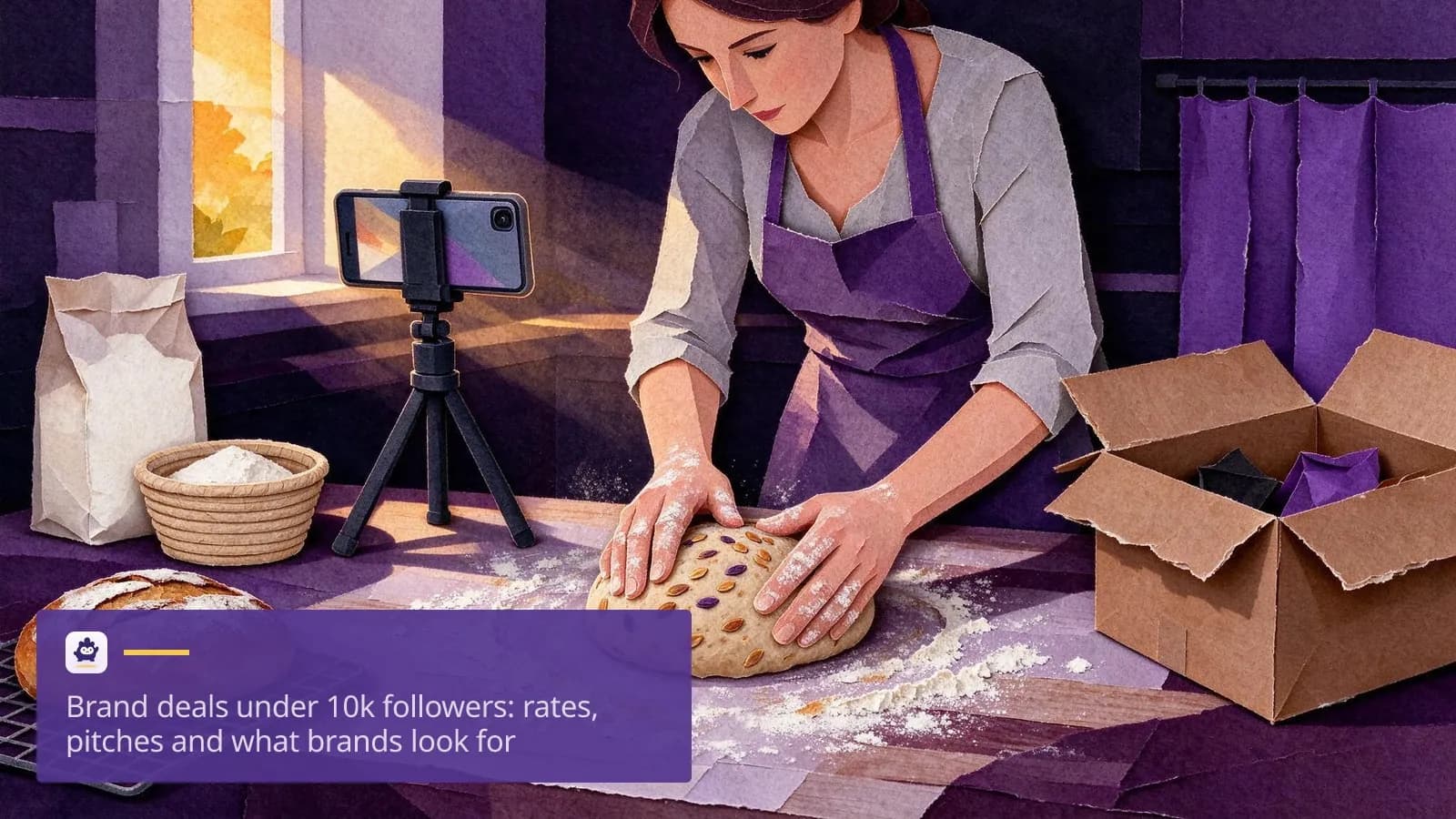
What makes this useful: A sourced EarnThread field guide written for creators turning attention into an owned business.
Brand deals under 10k followers are real but modest. The best campaign data available puts the median payment for creators under 10,000 followers at $134 per deliverable, and rate guides range from $10 for a small Instagram post to a few hundred dollars for a Reel or TikTok. Brands say they plan to work with more small creators, and what they look for is views, a clear niche and an audience that matches their customer. Pitch with your numbers, price on views rather than followers, label every paid post, and don't let sponsorships be your only income.
Key takeaways
- Completed campaign data from OpenSponsorship puts the median payment for creators under 10,000 followers at $134 per deliverable.
- Over half of brands in Influencer Marketing Hub's 2026 survey plan to increase or start work with nano and micro creators.
- Small creators win on views per follower and engagement, so price from average views rather than follower count.
- Label every paid or gifted post clearly at the start: the FTC, ASA and CCPC all expect it.
- Pair brand deals with an offer of your own, because brand budgets and campaign pay are uneven and can drop quickly.
What brand deals under 10k followers pay
There's no official rate card, so the honest answer is a range from several sources that measure different things.
| Source | What it measures | Under 10k followers |
|---|---|---|
| OpenSponsorship pricing analysis (July 2026) | Median actual payment, 146 completed nano campaigns, Jan 2025–Jun 2026 | $134 per deliverable |
| Influencer Marketing Hub Instagram rates (updated Oct 2026) | Planning benchmarks for Instagram | $10–$50 feed post, $20–$100 Reel, $5–$25 per Story frame |
| Later pricing benchmarks (July 2026) | Baseline ranges, 1k–10k followers | $100–$300 feed post, $200–$500 Reel or TikTok, $50–$150 Stories only |
The OpenSponsorship figure is the firmest because it's money actually paid on completed deals, but it's weighted towards sports, wellness, food and lifestyle brands and excludes gifted product. The two rate guides are starting points, not quotes; neither publishes how its ranges were built.
The same OpenSponsorship data shows how flat pricing is at the bottom: creators with 10,000–50,000 followers had a median of $150, only $16 more than the under-10k group.
Are brands actually hiring small creators?
Yes, and more of them plan to. In Influencer Marketing Hub's 2026 benchmark report (opens in a new tab), based on more than 600 respondents, 51.43% of respondents said they would increase or start work with nano creators and 52.83% with micro creators, compared with 20.59% for macro creators.
But the money is lopsided. CreatorIQ data reported by Net Influencer (opens in a new tab) in January 2026 found the average campaign payment across 14,400 paid creators was $11,400, but the median was $3,000, and the top 10% of creators received 62% of all payments. A few large deals pull the average up; most creators earn far less than headlines suggest.
Brand-deal income can also fall fast. Kajabi's State of Creator Commerce report (opens in a new tab) (1,717 respondents, April 2025) found brand-deal revenue down 52% year on year among its respondents.
What brands look for in a small creator
Small creators win on attention and fit, not reach. OpenSponsorship's campaign data shows why brands bother:
- Views per follower. Nano creators' posts drew 0.199 views per follower, against 0.046 for micro creators. A higher share of a small audience sees each post.
- Engagement per view. Nano campaigns had 4.6% engagement per view, the highest of any tier in that dataset.
- Cost per view. The median cost per view for nano creators was $0.13, similar to micro creators at $0.14.
Beyond the numbers, brands check things you can show in a pitch:
- 01A clear niche
"Home baking for beginners" is easier to buy than "lifestyle".
- 02Audience location
A UK skincare brand needs UK viewers. Have your platform analytics screenshot ready.
- 03Content quality
Good light, clear sound and a natural way of talking about products.
- 04Reliability
Briefs delivered on time, revisions handled without fuss.
- 05No risky history
Brands scroll back. Old posts that clash with their values cost deals.
Put it on one page
A one-page media kit saves you rewriting the same facts in every email. Keep it short and current:
- Your niche in one sentence, and the kind of viewer you serve.
- Average views per post over your last ten posts, per platform.
- Audience top countries, age range and gender split from your platform analytics.
- Two or three of your best posts with links, plus any past brand work.
- Your formats (Reels, TikToks, YouTube integrations, newsletter mentions) and starting prices.
- How to reach you.
Update the numbers monthly. Brands notice when a kit quotes a follower count from last year, and accurate small numbers earn more trust than vague big ones.
How to price a brand deal
Price on views, not followers. Followers tell a brand what's possible; average views tell it what it'll get.
Here's a simple method, using a hypothetical creator whose last ten Reels averaged 1,500 views:
- 01Start from cost per view
Multiply average views by a market cost per view. Using OpenSponsorship's nano median of $0.13, 1,500 views gives a base of about $195.
- 02Adjust for format and effort
A scripted video with a voiceover is more work than a single photo. Rate guides price Reels and video above static posts.
- 03Charge separately for usage rights
If the brand wants to run your video as an ad, that's a separate fee for a set period. Later's guide notes whitelisting adds 30–50% to the base rate.
- 04Charge for exclusivity
If the brand asks you not to work with competitors for months, that has a cost.
- 05Set a floor
Decide the lowest fee you'd accept for a day's work and don't go below it, even for brands you love.
Gifted product is not payment. Some small creators accept gifts to build a portfolio, but treat it as a choice, and the disclosure rules below still apply.
How to pitch brands under 10k followers
Most small creators wait to be found. Pitching yourself is faster. A pitch that works has five parts, in this order:
- 01One line on why this brand
Show you've used the product or know its customers.
- 02Your audience in numbers
Average views, top locations, age range, and the niche you post about.
- 03A specific idea
"A 45-second Reel showing how I use your planner for my weekly batch-cooking list" beats "a collaboration".
- 04Proof
Link two of your best posts and any past brand work, even unpaid.
- 05A clear price and next step
Give a rate or a starting package and ask for a call or a brief.
Here's what that looks like for a hypothetical home-baking creator pitching a flour brand:
I've used your strong bread flour in every loaf on my channel since spring, and my followers ask about it weekly. I post beginner bread tutorials to 6,200 Instagram followers, mostly in the UK, and my last ten Reels averaged 2,100 views. Idea: a 45-second Reel where I bake your seeded loaf recipe start to finish and share my one tip for a crisp crust. Two recent Reels are linked below. My rate for one Reel with three Stories is £220, with paid-ad usage priced separately. Could we set up a short call next week?
Keep it under 150 words. Send it to the brand's marketing or partnerships contact, not the generic customer-service inbox. Follow up once after a week.
Pitch brands your audience already asks you about. Comments like "what's that you're using?" are your best lead list.
Disclosure rules: FTC, ASA and CCPC
Every paid post, and in most cases every gifted one, must be labelled. The rules in the three main English-speaking markets are close:
- US: the FTC's Disclosures 101 for Social Media Influencers (opens in a new tab) says to disclose any financial, employment, personal or family relationship with a brand, including free or discounted products. Put the disclosure with the endorsement, not only in your bio, and not lost in a block of hashtags. In video, say it and show it. Don't rely on a platform's paid-partnership tool alone.
- UK: the ASA's guidance on recognising ads on social media (opens in a new tab) expects a prominent "ad" label upfront, before anyone clicks or watches. "Ad", "Advert" and "Advertising" are very likely to be acceptable. It advises against "sponsored", "gifted", "in association with", ambassador tags, and abbreviations such as "sp" or "spon".
- Ireland: the CCPC and ASAI's joint guidance (opens in a new tab) from October 2023 says commercial content should be labelled #Ad (or #Fógra in Irish), covers gifted items and your own brand too, and warns that non-compliance can lead to enforcement action up to and including prosecution.
If you post for audiences in more than one country, use the strictest version: "Ad" at the very start of the caption and on screen. This is general guidance, not legal advice.
Terms to check before you sign
Small creators often get sent short contracts or just an email brief. Before you agree, get these in writing:
- Deliverables: number of posts, formats, platforms and posting dates.
- Approval and revisions: how many rounds of changes are included.
- Usage rights: whether the brand can repost or run your content as ads, where, and for how long.
- Exclusivity: which competitors you can't work with, and for how long.
- Payment terms: amount, currency, invoice details and how many days until payment.
If a brand's terms feel one-sided, ask. Small brands in particular often send a template they're happy to adjust.
Don't build your income on brand deals alone
Brand deals are a good second income and a poor only one. Budgets move, briefs dry up, and a median of $134 a post means you need a lot of deals to replace a salary.
The creators in the data who earn steadily pair sponsorships with something they sell directly. Use your brand work to grow an email list and sell a product or service of your own. How to build an email list with a lead magnet and how to test demand for your first product are good next reads, and our guide to the ways creators make money shows how a free resource leads to paid offers.
EarnThread gives you the owned side: a mobile-first storefront for lead magnets, downloads, bookings and memberships, an audience CRM with consent tracking, and payments straight into your own Stripe account. When a brand post sends people to your page, attribution shows which post brought sign-ups and sales, which also gives you numbers to put in your next pitch. Start free on the Launch plan ($0 a month, 5% fee per sale), or compare plans.
Your next pitch
Brands pay small creators for attention and fit, so lead with views, niche and audience location, price from views, and label every paid post at the top. Write one pitch this week to a brand your audience already asks about, and set up a page of your own so every sponsored post also grows something you keep.
Frequently asked questions
How much should I charge for a brand deal with under 10k followers?
Start from your average views. OpenSponsorship's 2025–26 data shows a median cost per view of $0.13 for creators under 10,000 followers, so 1,500 average views suggests about $195 as a base. Add for video effort, usage rights and exclusivity. Its median actual payment for this group was $134 per deliverable.
How do I get brand deals as a small creator?
Pitch brands your audience already asks you about. Send a short email with why you like the brand, your average views and audience location, one specific content idea, two example posts and a price. Keep a one-page media kit ready and follow up once after a week. Don't wait to be found.
Do brands work with nano influencers?
Yes. In Influencer Marketing Hub's 2026 benchmark report, 51.43% of brands said they planned to increase or start working with nano creators and 52.83% with micro creators, compared with 20.59% for macro creators. Small creators also show higher views per follower and engagement per view in OpenSponsorship's campaign data.
Do I need to put #ad on gifted products?
In most cases, yes. The FTC treats free products as something of value that needs disclosure. The UK's ASA advises against using "gifted" alone as a label for ads. Ireland's CCPC and ASAI guidance covers gifted items within its labelling guidance. When unsure, label it clearly at the start of the post.